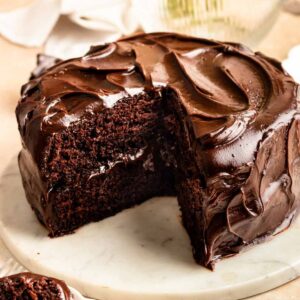
Best Matilda's Chocolate Cake
This Matilda chocolate cake has tender chocolate cake layers filled, frosted, and topped with the same rich fudge frosting as in the movie!
Ingredients
- 2 ½ cups Flour AP, plain flour
- 1 ¾ cups Granulated sugar
- 2 teaspoon Baking powder
- 1 teaspoon Baking soda
- ½ teaspoon Kosher salt
- ½ cup Cocoa powder Dutch processed cocoa powder
- ⅔ cup Vegetable oil or canola oil
- 1 teaspoon Vanilla extract
- 3 Eggs room temperature large eggs
- ⅔ cup Buttermilk
- 1 cup Coffee hot
Chocolate fudge frosting
- 11 oz Butter unsalted
- 14 oz Dark chocolate about 60%-70%
- ⅓ cup Cocoa powder Dutch processed
- 1 ⅓ cups Heavy cream
- 1 ⅓ cups Powdered sugar
- ½ teaspoon Kosher salt
- 1 teaspoon Vanilla extract
Instructions
Make the chocolate cake
- Prep: Preheat your oven to 175°C (350°F). Grease two 8-inch round cake pans and line the bottoms with parchment paper.
- Dry Ingredients: In a large bowl, sift together the flour, sugar, cocoa powder, baking soda, baking powder, and salt. Whisk to combine.
- Wet Ingredients: Whisk in the eggs, buttermilk, vegetable oil, and vanilla extract until smooth.
- Bloom: Pour the hot brewed coffee directly into the batter. Whisk gently until smooth and uniform. Note: The batter will be very thin.
- Bake: Divide the batter evenly between the two pans. Bake for 30 to 35 minutes, until a toothpick inserted into the center comes out clean. Cool in the pans for 10 minutes, then turn out onto a wire rack to cool completely.
Make the chocolate fudge frosting
- Strain through a fine mesh sieve into a shallow dish to remove any air bubbles.
- Place the frosting in the fridge until it thickens to a spreadable, fudgy consistency.
Assembly
- Place the first cooled cake layer on a serving plate or turntable. Spread a generous layer of the fudge frosting evenly over the bottom layer using an offset spatula. Top with the second cake layer.
- Spread the remaining fudge frosting smoothly over the top and sides of the entire cake, smoothing the top with your spatula for a sleek, glossy finish.
- Let the cake sit at room temperature for 15 minutes before slicing to allow the frosting to settle.
Notes
- Measuring Accuracy: For the best results, measure the flour and cocoa powder with a digital kitchen scale. Scooping directly with measuring cups can pack in extra flour, resulting in a dry sponge.
- Ingredient Temperatures: Use room temperature eggs and buttermilk so the wet ingredients blend smoothly without seizing the vegetable oil.
- Blooming Cocoa: Ensure the brewed coffee is steaming hot when added to the batter. The heat dissolves the cocoa solids instantly to unlock maximum flavor.
- Pan Preparation: Grease the cake pans thoroughly and line the bottoms with parchment paper rounds to guarantee the cake layers release cleanly.
- Gentle Heat for Frosting: Melt the dark chocolate, butter, heavy cream, and powdered sugar on the lowest stove setting while stirring constantly. High heat can break the emulsion and make the fudge dull or separated.
- Frosting Consistency: Stir the frosting every 10 minutes while it chills in the fridge until it reaches a spreadable texture. If it becomes too firm, set the bowl over a pot of warm water for 1 to 2 minutes to soften.
- Serving Temperature: Bring refrigerated cake slices to room temperature 20 to 30 minutes before serving. This softens the fudge frosting and restores the ultra-moist texture of the cake layers.
Nutrition
Calories: 710kcalCarbohydrates: 71gProtein: 8gFat: 51gSaturated Fat: 26gPolyunsaturated Fat: 8gMonounsaturated Fat: 13gTrans Fat: 1gCholesterol: 111mgSodium: 487mgPotassium: 370mgFiber: 6gSugar: 33gVitamin A: 971IUVitamin C: 0.1mgCalcium: 104mgIron: 5mg
Tried this recipe?Let us know how it was!