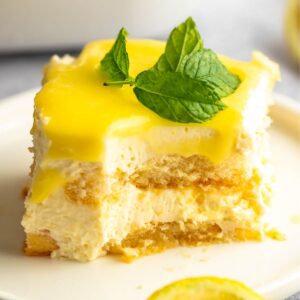
Lemon Tiramisu (No Raw Eggs + No Alcohol)
This Lemon Tiramisu is made with layers of tart homemade lemon curd, light mascarpone cream, and ladyfingers dipped in lemon syrup.
Ingredients
Mascarpone cream
- 2 cups Heavy cream cold
- 4 tablespoon Lemon juice Fresh
- 2 tablespoon Lemon zest Fresh
- ½ cup lemon curd
- ⅔ cup Powdered sugar
- 1 teaspoon Vanilla extract
- 15.87 oz Mascarpone cheese room temp
- 27 Ladyfingers
Lemon syrup
- 1 teaspoon Lemon zest Fresh
- 3 tablespoon Lemon juice Fresh
- ¾ cup Water
- ⅓ cup Granulated sugar
- 3 tablespoon Limoncello
Lemon curd
- ⅓ cup Lemon juice Fresh
- 1 tablespoon Lemon zest Fresh
- ⅔ cup Granulated sugar
- ⅓ cup Butter unsalted
- ¼ teaspoon Kosher salt
- 1 Egg
- 3 Egg yolks
Instructions
Make the lemon curd
- Combine the eggs, granulated sugar, fresh lemon juice, and lemon zest in a heavy-bottomed saucepan over medium-low heat.
- Whisk constantly for 5–7 minutes until the mixture reaches 180°F (82°C) or is thick enough to coat the back of a spoon.
- Remove from the heat and immediately whisk in the cold, cubed butter until completely melted, glossy, and smooth.
- Transfer the curd to a glass bowl. Press plastic wrap directly onto the surface to prevent a skin from forming, and refrigerate until completely cold (at least 2 hours).
Make the lemon syrup
- Dissolve: In a small saucepan, combine the water, sugar, lemon juice, and lemon zest. Place over medium heat and stir until the sugar is completely dissolved.
- Remove from the heat and let it cool completely. If using limoncello, stir it in now.
Prepare the mascarpone cream
- In a large bowl, whisk the room-temperature mascarpone cheese, ⅓ of your cooled lemon curd, powdered sugar, lemon juice, lemon zest, and vanilla extract until completely smooth and lump-free.
- Pour the cold heavy cream directly into the same bowl. Start your electric mixer on low speed to incorporate, then increase to medium-high. Whip the entire mixture together until it reaches thick, stiff peaks.
Assemble and top
- Briefly dip your ladyfingers into the cooled lemon syrup (1 second per side). Line the bottom of your 9x13 baking dish in a single layer.
- Spread half of your prepared mascarpone cream over the ladyfingers, then spoon half of your remaining lemon curd directly on top of the cream layer.
- Add a second layer of dipped ladyfingers, followed by the remaining mascarpone cream.
- Cover tightly and refrigerate for at least 8 hours (or overnight) to let the ladyfingers soften into a cake texture.
- Right before serving, spread the very last of the lemon curd smoothly over the top layer of cream.
Notes
- The Temperature Rule: Your mascarpone must be at room temperature to avoid stubborn lumps, but your heavy cream must be ice-cold to achieve maximum whipped volume.
- Don't Over-Soak: Ladyfingers act like literal sponges. A "one-Mississippi" count per side is all you need. If they are dripping wet, the dessert will pool water as it sets.
- The Sieve Secret: Always strain your homemade lemon curd through a fine-mesh sieve. Even if it looks smooth, the sieve catches tiny bits of chalazae or cooked egg, ensuring a professional, velvety finish.
- Whip with Caution: Because mascarpone has an incredibly high fat content, it can over-whip into separate clumps quickly. Stop your mixer the moment you see stiff, stable peaks.
Nutrition
Calories: 574kcalCarbohydrates: 49gProtein: 8gFat: 41gSaturated Fat: 25gPolyunsaturated Fat: 1gMonounsaturated Fat: 7gTrans Fat: 0.2gCholesterol: 213mgSodium: 194mgPotassium: 101mgFiber: 1gSugar: 25gVitamin A: 1492IUVitamin C: 10mgCalcium: 106mgIron: 1mg
Tried this recipe?Let us know how it was!