
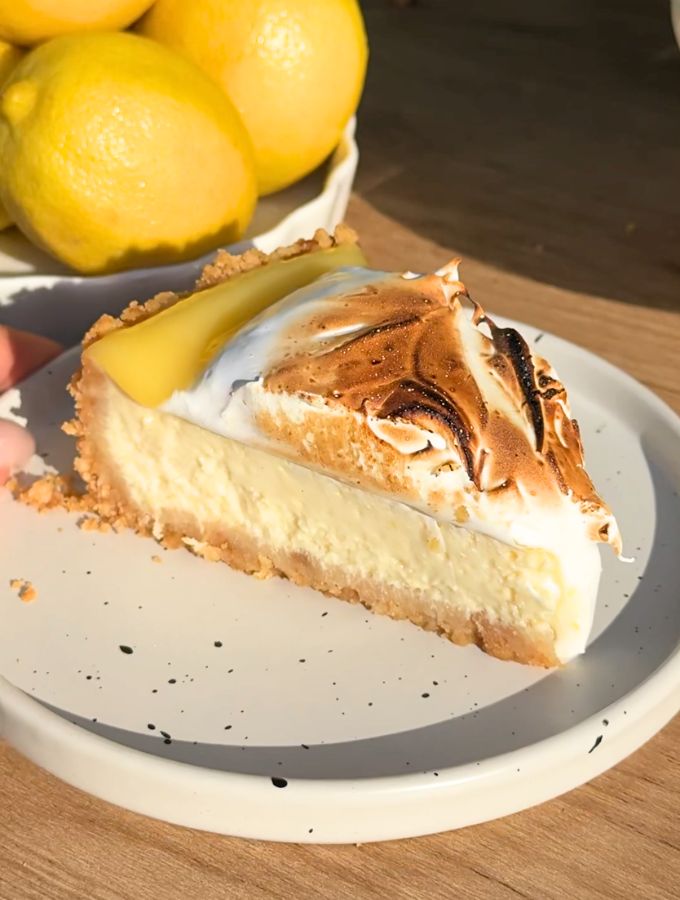
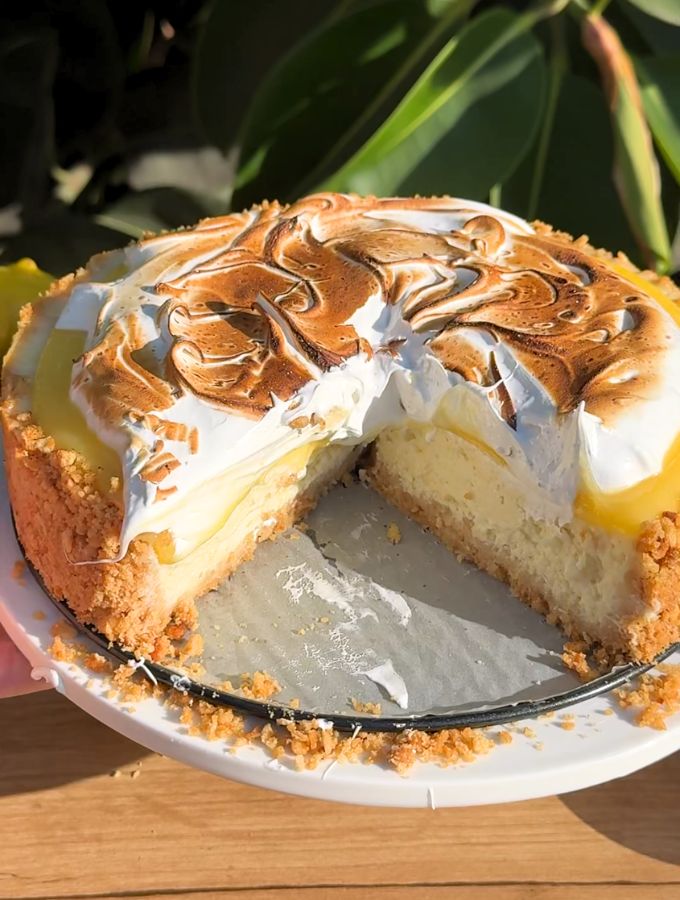
This lemon meringue cheesecake combines a graham cracker crust, a creamy lemon cheesecake filling, lemon curd, and a toasted Swiss meringue top.
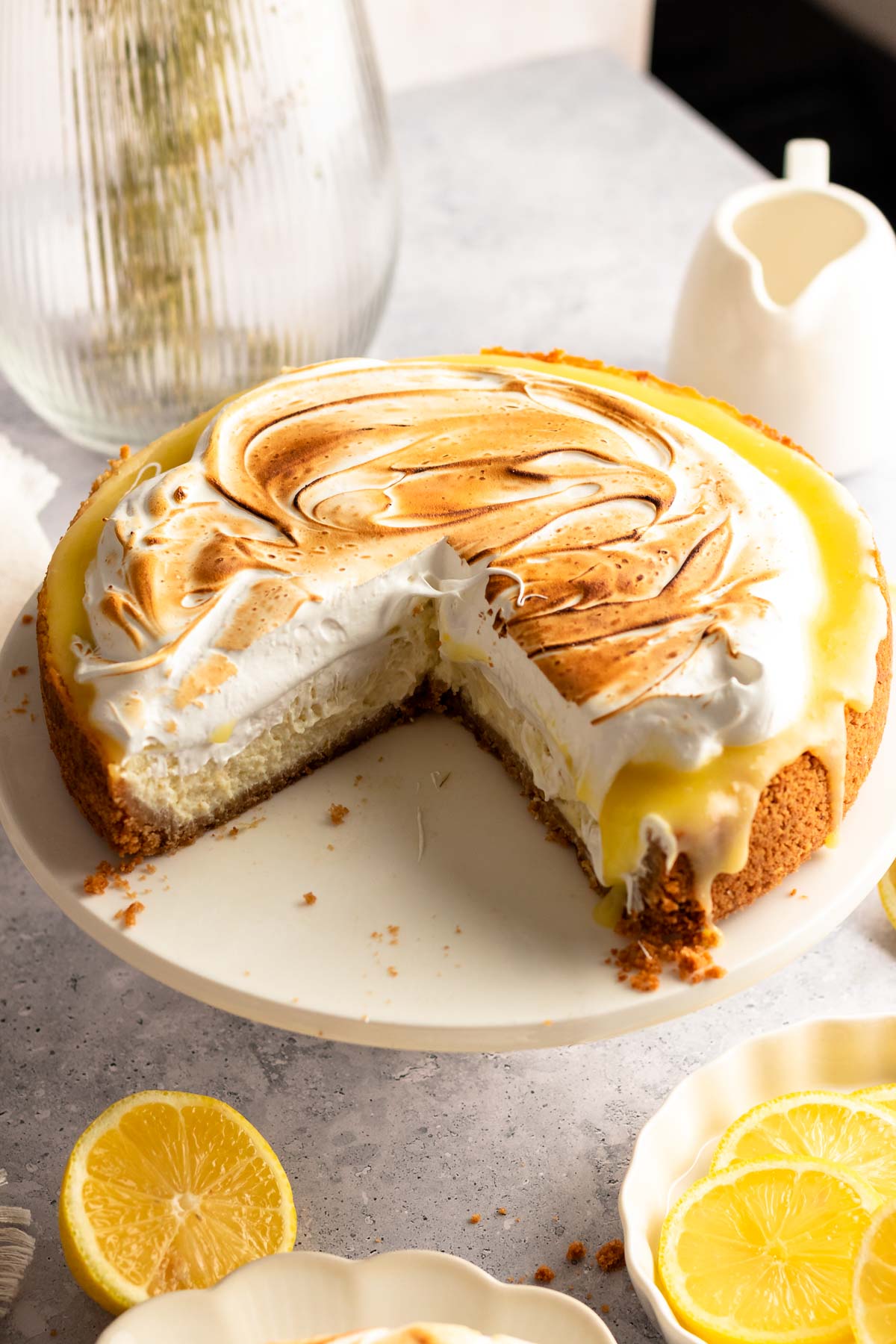
Baking cheesecake usually comes with the hassle of wrapping pans in foil and setting up a water bath, but this recipe skips all of that.
By baking the filling at a low temperature and letting it cool gradually in the oven, you get a flat, silky, crack-free finish every single time without the stress of water leaking into your crust.
It’s an absolute crowd-pleaser for spring gatherings, dinner parties, or whenever you’re craving a dessert that hits every textural note: crunchy, creamy, tart, and airy.
For more delicious cheesecake recipes, check out my 3-ingredient no-bake cheesecake, creamy vanilla cheesecake, pistachio cheesecake, and cinnamon roll cheesecake.
Jump to:
Why You’ll Love This Recipe
- Bold Lemon Flavor: Loaded with citrus from the lemon zest in the filling to the zesty curd and sweet meringue topping.
- No Water Bath Needed: Baked at a low temperature to give you a perfectly flat, crack-free cheesecake without messing with boiling water wraps.
- Textural Balance: Pairs a crunchy graham cracker crust with a velvety cream cheese center and an airy toasted meringue.
- Make-Ahead Friendly: The cheesecake base and lemon curd can be made in advance, leaving just the quick meringue topping for the day you serve.
Ingredients
Full measurements are located in the recipe card at the bottom of this post.
For the Graham Cracker Crust
Graham Crackers: About 1 ½ cups of fine crumbs. Digestive biscuits, vanilla wafers, or tea biscuits work as a 1:1 replacement outside the US.
Granulated Sugar: Adds a touch of sweetness to bind the crust.
Melted Butter: Unsalted butter holds the crumbs together. Melt in 30-second microwave pulses so it doesn't splatter.
For the Creamy Lemon Cheesecake Filling
Cream Cheese: Full-fat block cream cheese at room temperature is non-negotiable for a smooth, crack-free texture. I like to use Philadelphia.
Granulated Sugar: Sweetens and balances the tartness of the lemon. Can be swapped with caster sugar.
Cornstarch: Sifted into the batter at the very end to help bind moisture, build structure, and prevent cracks without overworking the flour gluten.
Eggs: Large room-temperature eggs add structure and richness.
Sour Cream: Full-fat sour cream lightens the batter and gives it a tender, melt-in-your-mouth crumb.
Fresh Lemon Zest & Juice: Zest first, then juice. Use fresh lemons for the best pop of flavor, avoid bottled juice.
Vanilla Extract: Enhances the citrus notes. Vanilla bean paste is a great upgrade!
For the Homemade Lemon Curd
Egg Yolks: Provide the rich base and thicken the curd naturally.
Granulated Sugar: Balances the sharp citrus bite.
Fresh Lemon Juice & Zest: Fresh juice is mandatory here for a vibrant, punchy flavor.
Unsalted Butter: Added off the heat for a glossy, silky texture.
For the Meringue Topping
Cream of Tartar: Stabilizes the egg whites for a glossy, stiff meringue. (Swap with ¼ teaspoon fresh lemon juice if needed).
Egg Whites: Separated carefully with zero yolk traces so the meringue whips up properly.
Granulated Sugar: Caster sugar or fine granulated sugar dissolves quickly over heat.
Instructions
Bake the Crust
Preheat oven to 350°F (180°C). Line the bottom of a 9-inch springform pan with parchment paper.
Pulse graham crackers in a food processor (or crush in a Ziplock bag with a rolling pin) until fine crumbs form.
Combine crumbs, sugar, and melted butter in a bowl until coated. Press firmly and evenly into the bottom of the prepared pan.

Bake for 7–8 minutes until lightly golden. Remove from the oven and let cool completely. Lower the oven temperature to 280°F (140°C).

Make & Bake the Cheesecake Filling
In a large bowl using an electric hand mixer on low speed, beat the room-temperature cream cheese, sugar, lemon zest, and vanilla extract until smooth and creamy.

Mix in the sour cream and fresh lemon juice until combined.

Add the room-temperature eggs one at a time, mixing on low speed just until incorporated after each addition. Do not over-mix.

Sift the cornstarch directly into the mixture and mix on low speed until smooth and fully combined with no lumps remaining.

Pour the batter over the cooled crust. Gently tap the pan on the counter a few times to release trapped air bubbles. Bake at 280°F (140°C) for 55–65 minutes, or until the edges are set but the center has a gentle wobble.
Turn off the oven, prop the oven door open slightly, and let the cheesecake sit inside for 1 hour to cool gradually.
Remove from the oven, wrap tightly with plastic wrap, and refrigerate for at least 5 hours (preferably overnight) to set.

Make the Homemade Lemon Curd
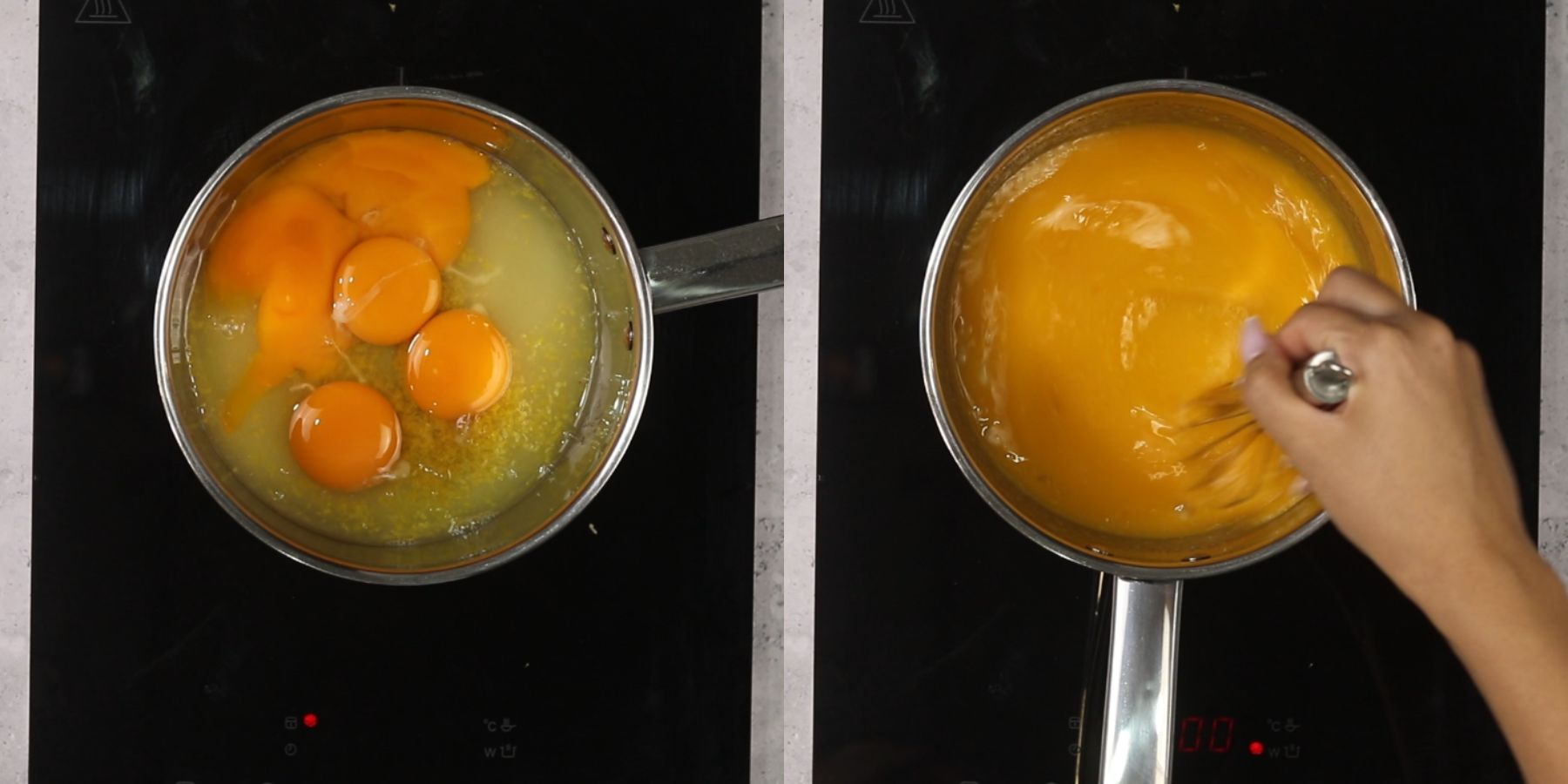
In a small saucepan off the heat, whisk together the egg yolks, granulated sugar, fresh lemon juice, lemon zest, and a pinch of salt until smooth.
Place the pan over medium-low heat. Cook, whisking constantly, for 5 to 7 minutes until the mixture thickens and coats the back of a spoon.
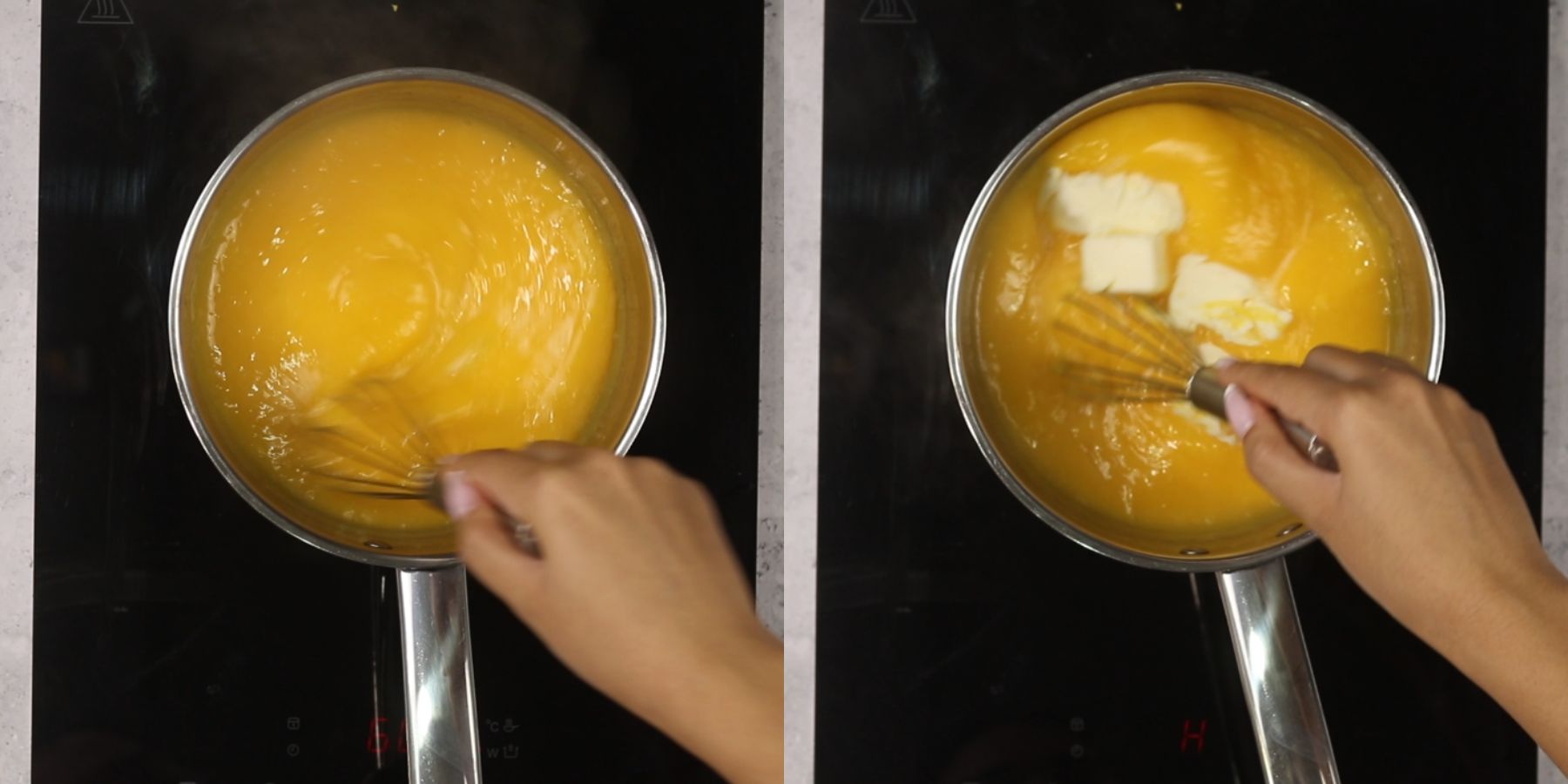
Remove from heat and stir in the cold butter pieces one at a time until completely melted and glossy.
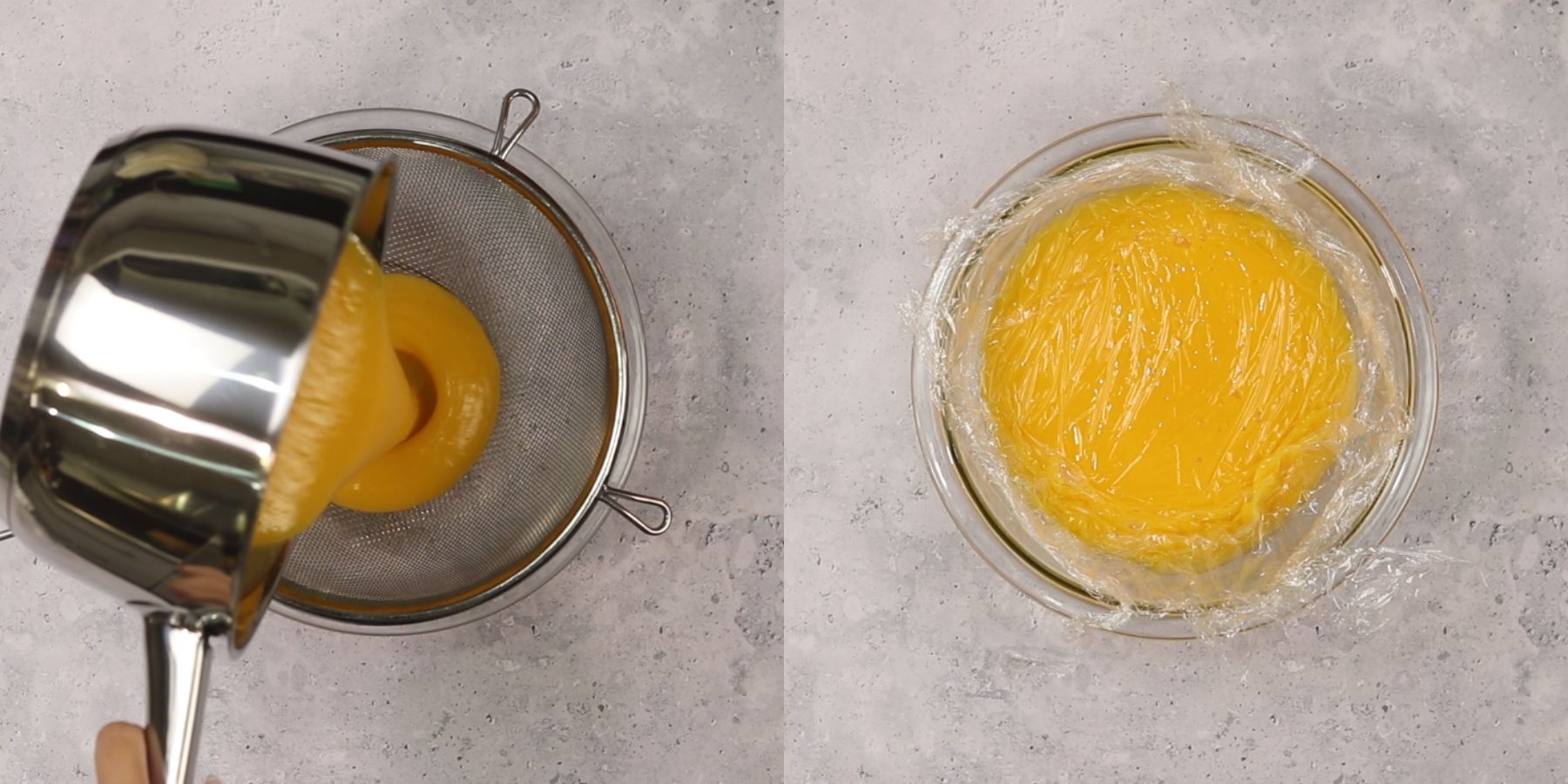
Strain through a fine-mesh sieve into a bowl, cover directly with plastic wrap touching the surface, and chill in the fridge until completely set.

Make the Swiss meringue & Assemble
In a heatproof bowl set over a saucepan of simmering water (double boiler setup), whisk egg whites, sugar, and cream of tartar constantly until the sugar completely dissolves and feels smooth between your fingers.
Transfer to a stand mixer (or use a hand mixer) and whip on high speed for 5–7 minutes until stiff, glossy peaks form.
Spread ½ cup of chilled lemon curd evenly over the top of the chilled cheesecake using an offset spatula.
Pile the meringue on top of the lemon curd, creating decorative swirls with a spatula. Use a kitchen torch to gently brown the meringue peaks before serving.

Baker’s Expert Tips for Success
- Use Room-Temperature Dairy & Eggs: Cold ingredients require excessive mixing to smooth out, which incorporates extra air and leads to cracks or sinking during baking.
- Mix on Low Speed: Keep your mixer speed low once the eggs are added to avoid whipping air into the batter.
- Don't Skip the Slow Cool: Leaving the baked cheesecake in the turned-off oven with the door propped open prevents sudden temperature drops that cause deep cracks.
- Release the Pan Edges: Once cooled to room temperature, run a thin butter knife around the inside edge of the pan before opening the springform latch.
Troubleshooting & FAQ'S
The outer 2 inches of the cheesecake should look set and matte, while the center should still jiggle slightly like jello when you gently shake the pan. The center will finish setting completely as it cools.
Cracks are usually caused by over-mixing eggs (incorporating too much air), baking at too high a temperature, or cooling the cake too quickly. Following the low-temp bake and slow-cooling method prevents this.
A kitchen torch gives you the most control without melting the lemon curd. If you don't have one, you can place the cake under your oven broiler on high for 1–2 minutes, but watch it constantly so it doesn't burn!
Storing
Store the assembled cheesecake covered in the refrigerator for up to 5 days.
Freezing
Freeze the plain baked cheesecake base without the curd or meringue topping. Wrap tightly in plastic wrap and aluminum foil for up to 3 months. Thaw in the fridge overnight, then add the curd and fresh meringue before serving.
Substitutions & Variations
Gluten-Free: Swap standard graham crackers with certified gluten-free graham crackers or digestive biscuits.
Citrus Swap: Replace the lemon zest and juice with lime, orange, or passion fruit for a different citrus twist.
The Pan Scaling Guide
To adjust the baking time and yield for different springform pan sizes, use the guidelines below:
- 8-Inch Springform Pan: Use 100% of the recipe. The cheesecake will bake up slightly taller and thicker. Bake at 280°F (140°C) for 65 to 75 minutes.
- 10-Inch Springform Pan: Use 100% of the recipe. The layers will be slightly thinner. Bake at 280°F (140°C) for 45 to 55 minutes.
- Individual Mini Cheesecakes (12-Cup Muffin Tin): Line a muffin tin with paper liners. Press 1 tablespoon of crust into each cup and pre-bake for 5 minutes at 350°F (180°C). Divide the filling evenly and bake at 280°F (140°C) for about 15 minutes until set. Top each chilled mini cheesecake with a spoonful of curd and a swirl of toasted meringue.
Equipment Needed
- Kitchen torch
- 9-inch springform pan
- Food processor
- Electric hand mixer or stand mixer
- Rubber spatula
- Offset spatula
More lemon desserts
Lemon tiramisu- Layers of lemon mascarpone cream and limoncello-dipped ladyfingers.
Limoncello mascarpone cake- A light, tender sponge layered with lemon curd and creamy mascarpone frosting.
Lemon tart- A buttery shortcrust pastry shell filled with zesty baked lemon curd.
Connect With Us
Review: Leave a rating and comment below if you enjoyed this recipe. Socials: Follow on Facebook, Instagram, and Pinterest. Save: Pin this recipe to Pinterest for later.
📖 Recipe

Lemon Meringue Cheesecake (W/ Lemon Curd)
Ingredients
For the crust
- 2 cups Graham crackers crumbs
- 1 stick Butter melted
- 1 tablespoon Granulated sugar
For the cheesecake
- 19.4 oz Cream cheese
- 1 cup Granulated sugar
- 3 teaspoon Lemon zest
- 1 teaspoon Vanilla extract
- 3.53 oz Sour cream
- 3 Eggs
- ¼ cup Lemon juice
- 2 tablespoon Cornstarch
For the lemon curd
- ⅓ cup Lemon juice
- 1 tablespoon Lemon zest
- ⅔ cup Granulated sugar
- 80 g Butter unsalted
- ¼ teaspoon Kosher salt
- 1 Egg
- 3 Egg yolks
For the meringue
- 3 Egg whites
- ¾ cup Granulated sugar
- ½ teaspoon Cream of tartar
Instructions
Bake the crust
- Preheat oven to 350°F (180°C). Line the bottom of a 9-inch springform pan with parchment paper.
- Pulse graham crackers in a food processor (or crush in a Ziplock bag with a rolling pin) until fine crumbs form.
- Combine crumbs, sugar, and melted butter in a bowl until coated. Press firmly and evenly into the bottom of the prepared pan.
- Bake for 7–8 minutes until lightly golden. Remove from the oven and let cool completely. Lower the oven temperature to 280°F (140°C).
Make & Bake the Cheesecake Filling
- In a large bowl, using an electric hand mixer on low speed, beat the room-temperature cream cheese, sugar, lemon zest, and vanilla extract until smooth and creamy.
- Mix in the sour cream and fresh lemon juice until combined.
- Add the room-temperature eggs one at a time, mixing on low speed just until incorporated after each addition. Do not over-mix.
- Sift the cornstarch directly into the mixture and mix on low speed until smooth and fully combined with no lumps remaining.
- Pour the batter over the cooled crust. Gently tap the pan on the counter a few times to release trapped air bubbles. Bake at 280°F (140°C) for 55–65 minutes, or until the edges are set but the center has a gentle wobble.
- Turn off the oven, prop the oven door open slightly, and let the cheesecake sit inside for 1 hour to cool gradually.
- Remove from the oven, wrap tightly with plastic wrap, and refrigerate for at least 5 hours (preferably overnight) to set.
Make the Homemade Lemon Curd
- Place the pan over medium-low heat. Cook, whisking constantly, for 5 to 7 minutes until the mixture thickens and coats the back of a spoon.
- Remove from heat and stir in the cold butter pieces one at a time until completely melted and glossy.
- Strain through a fine-mesh sieve into a bowl, cover directly with plastic wrap touching the surface, and chill in the fridge until completely set.
Make the Swiss meringue & Assemble
- Transfer to a stand mixer (or use a hand mixer) and whip on high speed for 5–7 minutes until stiff, glossy peaks form.
- Spread ½ cup of chilled lemon curd evenly over the top of the chilled cheesecake using an offset spatula.
- Pile the meringue on top of the lemon curd, creating decorative swirls with a spatula. Use a kitchen torch to gently brown the meringue peaks before serving.
Notes
- Room Temperature Ingredients: Make sure your cream cheese, sour cream, and eggs are at room temperature before starting. Cold cream cheese leads to lumps, and over-mixing cold batter to smooth them out incorporates trapped air that causes cracking during baking.
- Low & Slow Bake: Baking at 280°F (140°C) without a water bath requires patience, but it ensures a perfectly flat, crack-free surface. Don't rush the process or turn up the heat.
- Cooling Process: Do not skip the 1-hour rest in the turned-off oven with the door propped open. A drastic temperature change when pulling a hot cheesecake directly into room temperature air will cause it to sink or crack in the middle.
- Lemon Curd: You will need ½ cup of lemon curd to cover the cheesecake layer. If using the homemade recipe provided, store any leftover curd in an airtight jar in the fridge for up to 2 weeks (great for spreading on toast, scones, or mixing into yogurt!).
- Torch vs. Broiler: A kitchen torch gives you the most control when browning the meringue without melting the lemon curd underneath. If using an oven broiler, place the rack in the top position and watch it constantly—it will brown in under 60 seconds!
- Storing & Freezing: Store assembled cheesecake in the fridge for up to 5 days. For freezing, freeze the plain baked cheesecake base without curd or meringue for up to 3 months. Thaw overnight in the fridge before adding the toppings.
Betty says
This was by far the most decadent cheesecake I have ever made! Thank you for posting this recipe.